
By Ben Clark
So, you are interviewing an Enterprise Architect, Solution Architect, Product Architect, Enterprise Product Architect, Head of Architecture or Chief Architect. The list goes on. Unless you have conducted hundreds of interviews, they can be hard to interview. This is not like interviewing a developer, where you can set a quick technical test and then ask, “Please tell me about your weaknesses.”
Here are the top three things to be aware of.
In July 2026 there were over 600 architecture roles advertised in the UK alone, using 350 different job titles, all taken from publicly available information on LinkedIn. It is a minefield. An Enterprise Architect at one company can be an Infrastructure Architect at yours.
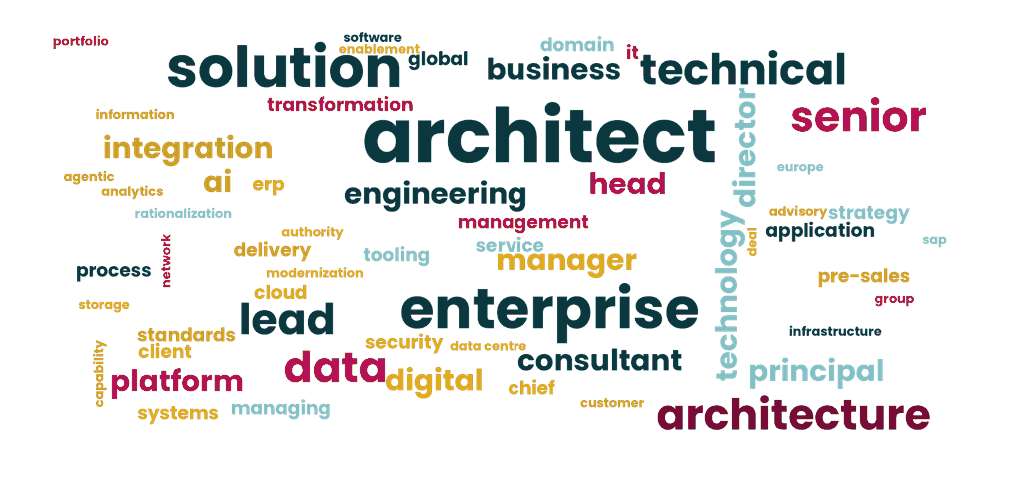
The 350 job titles used across UK architecture roles, July 2026.
The first thing to do when you review CVs is remove the job title. Yes, remove the job titles, look at their experience, what they have done and where they have done it, and focus on the top three bullet points of their CV. Nobody puts the work they spent the least time on, or are least proud of, at the top.
Then look at what they have done and construct questions around it that match your role, in relation to the specific domain, whether business or technology, where your role sits.
Business Architecture is an example. Like all architecture disciplines it has many variables. Someone with the job title Business Architect who only talks about designing processes is probably a Business Process Architect. If you are recruiting a Business Architect but your job spec talks about Motivation Models, Strategy on a Page and Business Capability Models, what you need is an Enterprise Business Architect. Your focus should not be on process questions, but on the higher-level artefacts, and on working out whether they are the business architect you want to hire.
Most architects are “great communicators”. Roughly translated, that can mean they talk a lot, and I mean a lot. Sometimes it means they say a lot without saying much at all.
To interview an architect well, you need to dig deep into what they have done and what you need them to do. A technique I was taught years ago, which works better in person than on Teams or Zoom, is golden silence, from the sales training company Miller Heiman. You ask the question and the person answers, often with very little depth or substance. They get to the end of the answer, and you stay silent, or nod in an understated, encouraging way, to keep them talking. You will then get a slightly better answer. When they finish, you pull the same trick again.
This is where it gets really awkward, and I mean 30 to 60 seconds of silence. If you can get them to carry on, they have to answer with a great deal of depth and authenticity, because the previous two silences have stripped the veneer away, and you see how they cope under pressure, since this will feel like a very stressful situation for them.
I do not recommend doing this on every question, as the interviewee will feel like they are being interviewed by a psychopath or someone on The Apprentice. Once or twice on key questions is enough.
A lot of people make the mistake of recruiting in their own image: similar backgrounds, education, interests. I remember a graduate recruitment agency that contacted me back in July 2000 saying they wanted someone who liked football and beer. I thought that was perfect. It really was not. You have to look beyond yourself and think about the people your architect will be facing off against. That is often the key in architecture recruitment.
Architecture is an influential role. It may not have much power, but it often carries great responsibility. It rarely carries a budget beyond operational resources, and very few Chief Architects report to the CIO.
Whatever type of architect you are recruiting, they will have stakeholders. Solution Architects are likely to face off with engineering functions, Enterprise Architects with the business, and in a smaller architecture function both are common. So look beyond the day-to-day involvement you will have with this person, and think about the people who have to say yes to any recommendation your architect makes. One key is to watch their energy levels and how they make you feel.
In December 2025 I had a role for a leading global company. I knew the hiring manager well, and I then met their architecture peer, Fernando, a very unassuming but technically competent guy. I then had a drink with their key stakeholder, an absolute hoot of a Delivery Director we shall call Charlotte. I sensed that Charlotte did not have much time for Fernando’s way of working, so I discreetly asked whether she needed someone more proactive, front-footed and energetic. She said yes. So I made my shortlist decision on who would work best with Charlotte first, and the existing architecture team second. The person who was hired has done an incredible job. If I had not met Charlotte, I would have recommended someone else, and who knows from there.
Use these as the questions worth staying silent on.
Recruiting any form of architect is complicated, and like any form of recruitment, it is impossible to get right every time. The more you learn to cut through the white noise, learn the nuances and dig deep, the better you will get.
Ben Clark is the founder of Konvergent, an architecture recruitment and consultancy business he set up in 2015. He has spent 25 years in the architecture market and has interviewed thousands of architects. Konvergent works on an engaged search basis only, and counts BT, Vodafone, Arup, Network Rail, Tesco, Accenture and Kier among its clients.
If you would rather not sift the CVs yourself, this is exactly what our engaged search for permanent architects is built to do.
Or book a free Role Clarity Call. In 30 minutes we will help you work out which architect you actually need, whether or not you go on to work with us.
| Cookie | Duration | Description |
|---|---|---|
| cookielawinfo-checkbox-analytics | 11 months | This cookie is set by GDPR Cookie Consent plugin. The cookie is used to store the user consent for the cookies in the category "Analytics". |
| cookielawinfo-checkbox-functional | 11 months | The cookie is set by GDPR cookie consent to record the user consent for the cookies in the category "Functional". |
| cookielawinfo-checkbox-necessary | 11 months | This cookie is set by GDPR Cookie Consent plugin. The cookies is used to store the user consent for the cookies in the category "Necessary". |
| cookielawinfo-checkbox-others | 11 months | This cookie is set by GDPR Cookie Consent plugin. The cookie is used to store the user consent for the cookies in the category "Other. |
| cookielawinfo-checkbox-performance | 11 months | This cookie is set by GDPR Cookie Consent plugin. The cookie is used to store the user consent for the cookies in the category "Performance". |
| viewed_cookie_policy | 11 months | The cookie is set by the GDPR Cookie Consent plugin and is used to store whether or not user has consented to the use of cookies. It does not store any personal data. |