Clarity is often elusive world of corporate technology and strategy. That was precisely the dilemma faced by the Contracts and Procurement Department of a major player in the transportation and infrastructure sector. They initially contacted Konvergent with a straightforward query: could existing technology be more efficiently employed, and could sub-optimal systems be supplanted? What transpired was a journey from technological tinkering to strategic enlightenment.
Rather than immediately diving into the technology stack, Konvergent posed crucial questions:
This exercise revealed a fragmented operational ethos, driven by a culture prioritising execution over strategic alignment. Consequences of this was an existing project portfolio that was shown not be be addressing key and universal pain points and a history of failed technology adoption Konvergent advocated for a holistic methodology that melded overarching strategy with evaluating business capabilities and technological resources.
A PWC study found that in 70% of unsuccessful projects, the failure is “due to a lack of user adoption and behavioural change.” With the key ask ultimately driving long-lasting change we knew that we had to produce something that would take a large stakeholder group on a journey and drive consensus to ensure that user adoption and long-term behavioural change are achieved.

Interactive Engagement: In place of a cumbersome 150-page PowerPoint—often a ticket to corporate apathy and £500,000 worth of deliverables from the Big 4—Konvergent crafted an interactive portal to enable all information to be available within a few clicks. This was met with stellar reviews and far exceeded client expectations.
Consensus Building: Agreement on vital issues like data management was reached, a notorious pain point in cross-departmental strategy.
Financial Prudence: A £485,000 data analytics project, that had no allgined to any strategic was scrapped, saving resources and enabling the freed funds to set up a transformation programme for 2024.
C-Suite Validation: The project’s impact went up to the C-suite, exemplified by the Commercial and Procurement Contracts Director, who lauded the results as “better than I expected.” It was commented by the sponsor “that there is a buzz about this that I have not seen before.”
Konvergent’s deliverables spanned various domains, which were all interlinked:
Business Motivational Model: This was the first on-a-page view that the department ever had and helped filter out initiatives that lacked alignment with strategic goals.
Business Capability Model: It decomposed the core competencies of the department, shedding light on the functions, data, and apps that buttress each area.
Application Portfolio Model: A catalogue of applications in current use—like revealing an octet of applications merely for contract management.
Strategic Roadmap: A compendium of high-impact projects and ‘no-regret’ initiatives that promise immediate and future value. With the filtering element simply not possible in PowerPoint, it enabled a focus on projects classified as quick wins or no regrets.
Insights & Recommendations: A distilled wrap-up, segmenting challenges and opportunities into five thematic clusters for easier digestion.
The deliverables eschewed the pedestrian PowerPoint format. They employed visual interactivity that garnered buy-in, driving discussions and enabling decisions on significant financial commitments for the future.
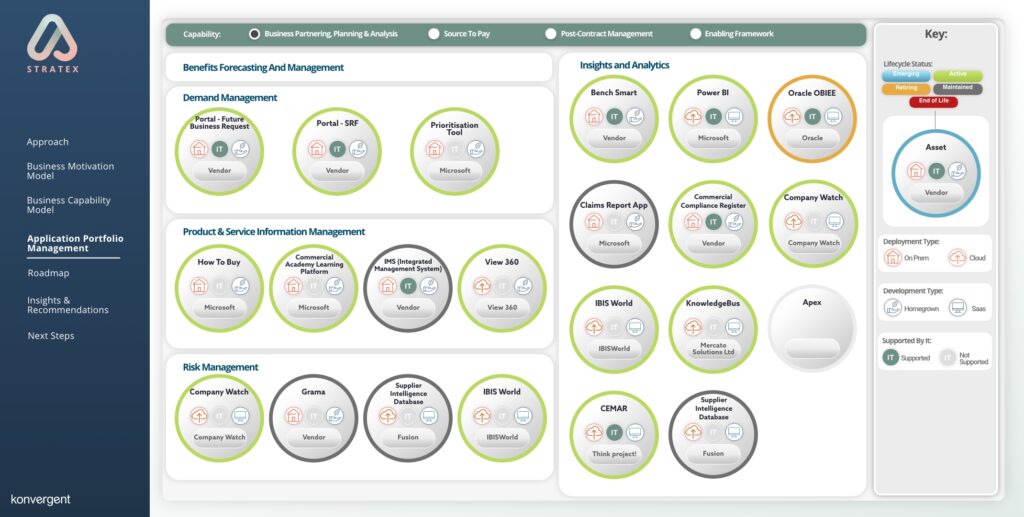
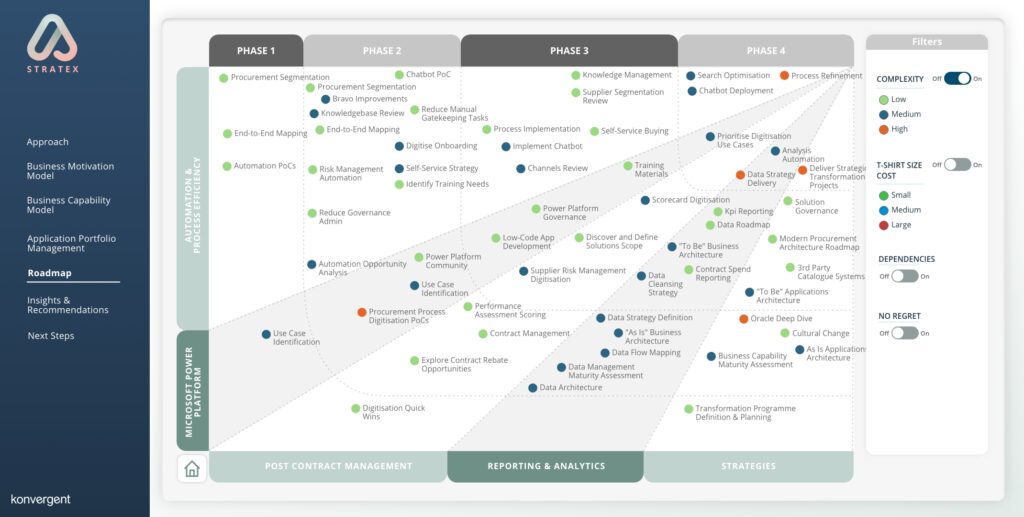
With the project serving as a linchpin for imminent multi-million-pound investments, it’s become a pivotal reference document. It delivers a granular yet panoramic view of the department’s current state, future potential, and the roadmap bridging the two.
In summary, Konvergent didn’t just fulfil a brief; they reframed it, turning a quest for technological enhancements into a strategic awakening. The resultant transformation isn’t merely on paper or confined to a slide deck; it’s manifesting in boardroom conversations and operational recalibrations. And that is the essence of strategy, not just in documents but in organisational DNA.
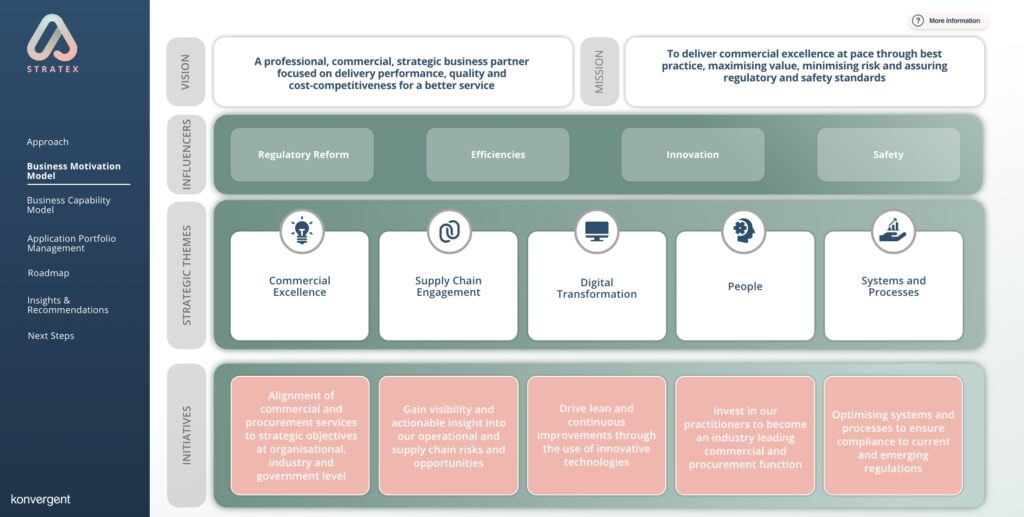
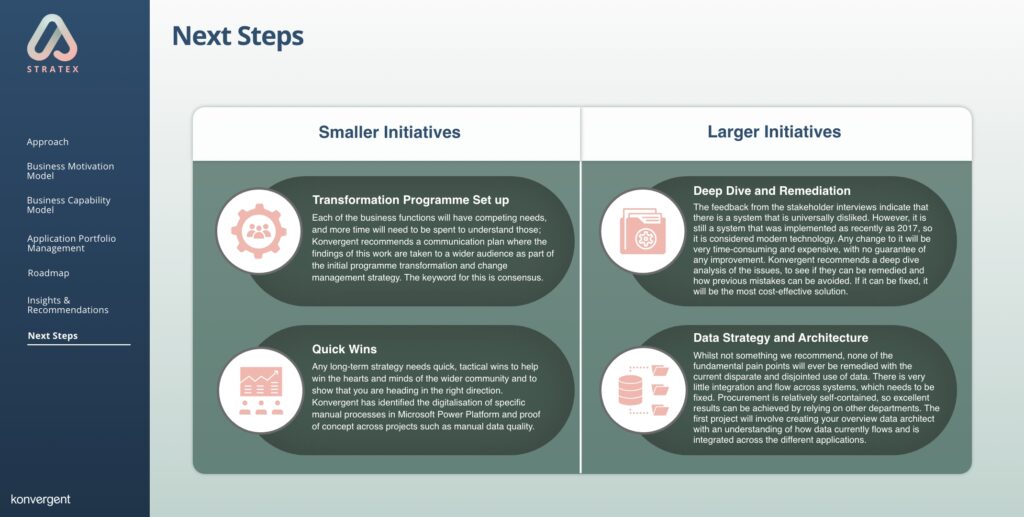
In strategy and architecture, an often-neglected aspect is the Return on Investment (ROI). As financial professionals demand concrete figures when considering investments, more than a mere mention of process improvement or technology optimisation may be required. In their eyes, such endeavours represent costs, making it challenging to secure the necessary funding. Considering this, it is crucial to demonstrate ROI, regardless of how impressive a project’s visual outputs may be.
“Value is a number, everything else is noise”
Konvergent,
The Hoxton, 70 Colombo St,
London,
SE1 8DP
T: +44 (0)20 3744 1256
E: info@konvergent.co.uk
| Cookie | Duration | Description |
|---|---|---|
| cookielawinfo-checkbox-analytics | 11 months | This cookie is set by GDPR Cookie Consent plugin. The cookie is used to store the user consent for the cookies in the category "Analytics". |
| cookielawinfo-checkbox-functional | 11 months | The cookie is set by GDPR cookie consent to record the user consent for the cookies in the category "Functional". |
| cookielawinfo-checkbox-necessary | 11 months | This cookie is set by GDPR Cookie Consent plugin. The cookies is used to store the user consent for the cookies in the category "Necessary". |
| cookielawinfo-checkbox-others | 11 months | This cookie is set by GDPR Cookie Consent plugin. The cookie is used to store the user consent for the cookies in the category "Other. |
| cookielawinfo-checkbox-performance | 11 months | This cookie is set by GDPR Cookie Consent plugin. The cookie is used to store the user consent for the cookies in the category "Performance". |
| viewed_cookie_policy | 11 months | The cookie is set by the GDPR Cookie Consent plugin and is used to store whether or not user has consented to the use of cookies. It does not store any personal data. |